- Restart your Mac first.
- Often, a quick restart can fix Touch Bar problems by refreshing system processes and clearing out temporary glitches.
- Reset NVRAM and SMC if the issue persists.
- If restarting doesn’t help, try resetting the NVRAM (non-volatile RAM) and SMC (System Management Controller) to address deeper hardware-related Touch Bar problems.
- Update macOS to the latest version.
- Keeping your macOS up to date ensures you benefit from the newest bug fixes and enhancements for the Touch Bar from Apple.
- Use Terminal to restart Touch Bar processes.
- By running specific Terminal commands, you can quickly restart the Touch Bar’s background processes without rebooting your entire system.
- Get the best Mac tools all in one place.
- Fix Touch Bar problems and boost your Mac’s performance with powerful utilities. Explore over 250 Mac apps with a 7-day free trial of Setapp.
The MacBook Pro Touch Bar, introduced between 2016 and 2020, was a sleek and promising innovation in tech. It let you easily adjust brightness and volume, control music and media, and more. If these features were a big reason you chose that laptop, it’s especially frustrating when the Touch Bar stops working.
But don’t worry — I’ll walk you through several simple ways to fix the Touch Bar on your MacBook Pro.

What is the Touch Bar?
The Touch Bar is a dynamic, interactive display that replaced the traditional function keys on MacBooks. This innovative Retina touchscreen offers typing suggestions, emoji access, familiar function keys, and app-specific controls. For instance, you could change text color in Microsoft Word or play and pause music right from the Touch Bar. Instead of a fixed set of keys, Apple designed it to deliver a more adaptable and personalized experience.
You may have noticed I’m referring to it in the past tense—that’s because it was discontinued in 2021. This decision came down to declining interest and popularity among users. People also appreciate the tactile feedback of a physical keyboard, which is why laptops haven’t fully replaced keyboards with touch panels, and why mechanical keyboards continue to grow in popularity.
How to fix your MacBook Touch Bar when it’s not working
If your MacBook Pro Touch Bar has suddenly disappeared or isn’t working like it used to, what should you do next? Maybe you’ve already tried restarting your laptop or updating macOS, but neither helped. Here are some effective solutions to get your Touch Bar back up and running.
#1. Force Quit Apps
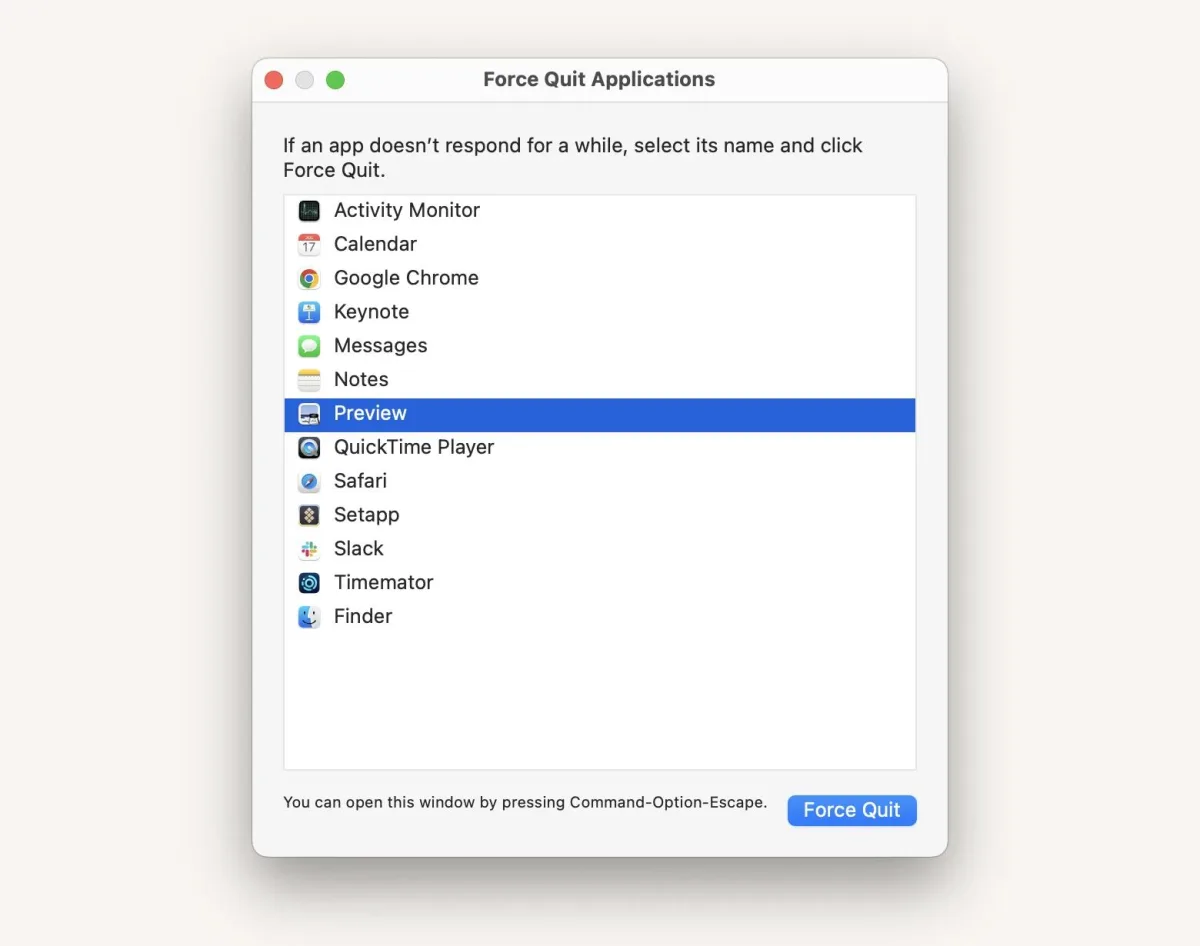
Sometimes, apps running in the background can cause system-wide glitches, and the Touch Bar isn’t immune. Force quitting apps can completely stop their processes, including hidden ones, which might instantly clear up any issues you’re experiencing. To force quit an app:
- Click the Apple icon in the top-left corner of your screen.
- Choose Force Quit from the menu.
- Select the app you want to close, then click Force Quit. To select multiple apps, hold down the Command key while clicking each one.

To open the Force Quit window using a keyboard shortcut, press and hold Option + Command + Esc.
#2. Reset the Touch Bar
There are two ways to reset the Touch Bar. The first method involves using your Mac’s Activity Monitor:
- Open Activity Monitor by navigating to Applications > Utilities, or simply use Spotlight Search.
- Type TouchBarServer into the search bar.
- Select TouchBarServer from the list, then click the X button.

- In the pop-up window, choose Force Quit to reset the Touch Bar.
The Touch Bar server will restart automatically on its own.
How to Restart the Touch Bar Using Terminal
Another way to restart the Touch Bar is through Terminal. Here’s a quick guide:
- Open Terminal by navigating to Applications > Utilities or by using Spotlight Search.
- Enter the command sudo pkill touchbarserver and hit Return on your keyboard.
- Enter your admin password when prompted and press Return. Note that no characters will appear as you type.

Although you won’t receive any confirmation, the Touch Bar should reset automatically.
#3. Update your macOS
Keeping your macOS up to date ensures you receive the latest security patches and fixes, preventing glitches and performance issues—including those affecting your Touch Bar. To update your macOS:
- Open your System Settings.
- Click on Software Update Available under your Apple Account.
- Select either Update Tonight or Restart Now, depending on when you’d like to begin the update.

If you don’t see a Software Update option under your Apple Account, it means you probably have the latest version of macOS installed.
#4. Check Your Keyboard Settings
Sometimes, simply reviewing your keyboard settings can reveal if something’s off with your Touch Bar. Here’s how to check:
- Go to your System Settings.
- Scroll down and select Keyboard.
- Click on Touch Bar Settings.

- Toggle Show Control Strip on, and make sure your Touch Bar is set to App Controls.
If you’ve ever adjusted the Touch Bar settings or customized the Control Strip, you might have accidentally switched something on or off or picked the wrong option.
For a more powerful way to customize your Mac, I recommend trying BetterTouchTool. It offers a simple, all-in-one solution to manage your Touch Bar widgets, gestures, keyboard shortcuts, and much more. It’s especially handy if you want to redesign your Touch Bar with unique layouts and create new functional buttons. Check out what it can do!

#5. Refresh the Control Strip
The Control Strip is the section on the right side of the Touch Bar that holds key controls like brightness and volume. If that area isn’t responding correctly, refreshing the Control Strip might fix the issue. Here’s how to do it:
- Open Terminal by going to Finder > Applications > Utilities, or simply use Spotlight Search.
- Type killall ControlStrip and press the Return key.

Once you run this command, your Control Strip should restart and start working properly or display as expected.
#6. Reset the SMC and NVRAM
The SMC (System Management Controller) and NVRAM (Non-Volatile Random Access Memory) play key roles in keeping your MacBook running smoothly. They manage important features like your display and the Touch Bar. Resetting one or both can often fix a range of issues quickly.
To reset your SMC:
- Shut down your MacBook.
- Connect your power adapter.
- Press and hold Shift + Control + Option along with the power button.
Your adapter will change color, signaling that the SMC has been successfully reset.
Follow these steps to reset your NVRAM:
- Restart your laptop.
- As soon as it powers on, press and hold Command + Option + P + R until you hear the startup chime for the second time.
For step-by-step guidance, check out our detailed guide on how to reset PRAM/NVRAM and SMC on your Mac. This process can often resolve performance problems and fix corrupted NVRAM settings.
Now you know how to reset the Touch Bar on your MacBook Pro!
Although Apple no longer includes the Touch Bar on its laptops, many users still appreciate its unique features. When glitches or malfunctions occur, there are several ways to restore your Touch Bar. Whether it’s simply resetting your MacBook, restarting the Touch Bar itself, or performing a hard reset on your SMC, following these steps usually fixes common issues.
Core Shell, BetterTouchTool, and QuitAll are great apps to help you manage your Touch Bar. These, along with over 250 other apps, are available with a 7-day free trial of Setapp — an all-in-one subscription service offering native macOS apps for everything from organization to system optimization.
FAQ
How to enable the Touch Bar on a MacBook Pro?
If your Mac’s Touch Bar isn’t showing or has been disabled, you can easily turn it back on. Just go to System Settings > Keyboard > Touch Bar Settings. In the pop-up window, make sure Show Control Strip is enabled and that it says App Controls next to Touch Bar shows.
No light on my MacBook Pro Touch Bar — what to do?
If your MacBook Pro’s Touch Bar isn’t lighting up, it could be a hardware issue that often requires resetting the SMC or NVRAM. The System Management Controller (SMC) handles key hardware functions, while the Non-Volatile Random-Access Memory (NVRAM) stores settings that help your Mac start up smoothly. To reset the SMC, shut down your MacBook, connect the power adapter, then press and hold Shift + Control + Option + Power button simultaneously. If that doesn’t work, try resetting the NVRAM by restarting your Mac and holding down Command + Option + P + R keys.
MacBook Pro Touch Bar not working after water damage — what to do?
Water damage can seriously affect your MacBook’s keyboard, trackpad, and Touch Bar. Before scheduling a Genius Bar appointment, back up your data and power off your laptop to let it dry. Using cooling fans and soft towels can help, but avoid heat sources since they might cause more damage. Allow your MacBook to dry completely for several hours or longer before turning it back on. If the problem persists, reach out to Apple Support for assistance.
MacBook Pro Touch Bar Not Showing Volume? Here’s How to Fix It
If your volume controls are missing or unresponsive on the Touch Bar, it might be due to a settings glitch or a simple need to restart your MacBook. Begin with a standard restart, or try resetting the NVRAM by holding down Option + Command + P + R right after your Mac restarts. Also, ensure your macOS is up to date by installing any available updates. If the issue persists, reset the Touch Bar by restarting your Mac and holding Command + R until the Apple logo appears, which will restore its default settings.